
For many businesses and fleet operators, the biggest obstacle to installing EV chargers isn’t the chargers themselves. It’s the electricity needed to power them.
A facility may have plenty of parking space for 10, 20 or even 50 EV chargers, but that doesn’t mean the existing electrical service has enough available capacity to run all of those chargers at full power simultaneously.
The traditional answer is to increase the building’s electrical capacity through a utility service upgrade. But that can mean additional equipment, construction, utility coordination, expense and potentially significant delays.
Fortunately, an electrical service upgrade isn’t always necessary.
With thoughtful EV charging engineering, intelligent load management and, when appropriate, solar generation and battery energy storage, it may be possible to support substantially more EV charging using the electrical capacity you already have.
Our subsidiary, Paired Power, provides solutions for pairing EV charging with solar, battery storage and energy management software to help charge as many as 6-12 EVs with the power typically needed for just one.
Why EV Chargers Can Overwhelm Existing Electrical Service
A single Level 2 charger might not seem like an enormous electrical load. Multiply that load across an entire workplace parking lot or fleet depot, however, and the numbers add up quickly.
DC fast chargers can create an even greater demand.
The problem becomes especially apparent when multiple vehicles plug in at approximately the same time. If every charger immediately attempts to draw its maximum rated power, the site’s peak electrical demand can increase dramatically.
That can create two separate problems:
- The facility may not have enough available electrical capacity to support the chargers.
- Even if sufficient capacity exists, allowing every charger to operate at full power simultaneously can create expensive utility demand charges.
Simply calculating the combined nameplate capacity of the chargers, however, doesn’t tell the whole story.
The better question is: How much energy does each vehicle actually need, and when does it need it?
Your EV Chargers Probably Don’t Need Full Power All the Time
Consider a workplace where employees arrive around 8:00 a.m. and leave around 5:00 p.m.
A vehicle may be plugged into a charger for nine hours, but it may only need a few hours—or less—of actual charging to replace the energy consumed during the driver’s commute.
Fleet vehicles present a similar engineering opportunity. Some vehicles may return to a depot at 4:00 p.m. but don’t need to leave again until 6:00 a.m. Others may require a faster turnaround.
Rather than treating every connected EV as if it needs maximum charging power immediately, a properly designed system can consider factors such as:
- Available electrical capacity
- Number and type of EVs
- Daily miles driven
- Required vehicle range
- Vehicle arrival and departure times
- Required charging speeds
- Charger types
- Utility electricity rates
- Peak demand
- Other facility electrical loads
Once those variables are understood, charging can be intelligently distributed across the available time and power.
Smart Load Management Can Help You Install More EV Chargers
This is where EV charger load management becomes extremely valuable.
Instead of allowing every charger to operate independently at maximum power, an energy management system can coordinate charging across the site.
Imagine that your facility has only 100 kW available for EV charging, but the chargers could theoretically consume 300 kW if they all operated at full power simultaneously.
That doesn’t necessarily mean you need to upgrade the facility to provide 300 kW.
An intelligently managed system can allocate the available 100 kW among the vehicles based on their actual charging requirements and operational priorities.
Power can be increased, decreased, delayed or redistributed as vehicles connect, complete charging or prepare for departure.
The objective isn’t simply to charge vehicles as fast as possible.
It’s to make sure the vehicles have the energy they need when they need it while staying within the site’s electrical constraints.
Solar and Battery Storage Can Increase the Energy Available for EV Charging
Sometimes load management alone is enough to avoid or reduce the scope of an electrical service upgrade.
In other situations, additional on-site energy resources can make an even bigger difference.
Solar photovoltaic systems can generate electricity on site, while battery energy storage systems can store energy and discharge it when charging demand is high.
Together, the grid, solar generation and battery storage can function as an integrated energy system.
This approach can be particularly useful at locations where utility capacity is constrained or where obtaining additional grid capacity would be expensive or time-consuming.
Instead of thinking of the grid as the only source of electricity available to your EV chargers, engineers can evaluate how multiple energy sources can work together to meet charging demand.
Real-World Example: Charging Six Times More EVs With Existing Grid Capacity
This isn’t merely theoretical.
McCalmont Engineering’s subsidiary, Paired Power, specializes in integrating EV charging with distributed energy resources and intelligent energy management.
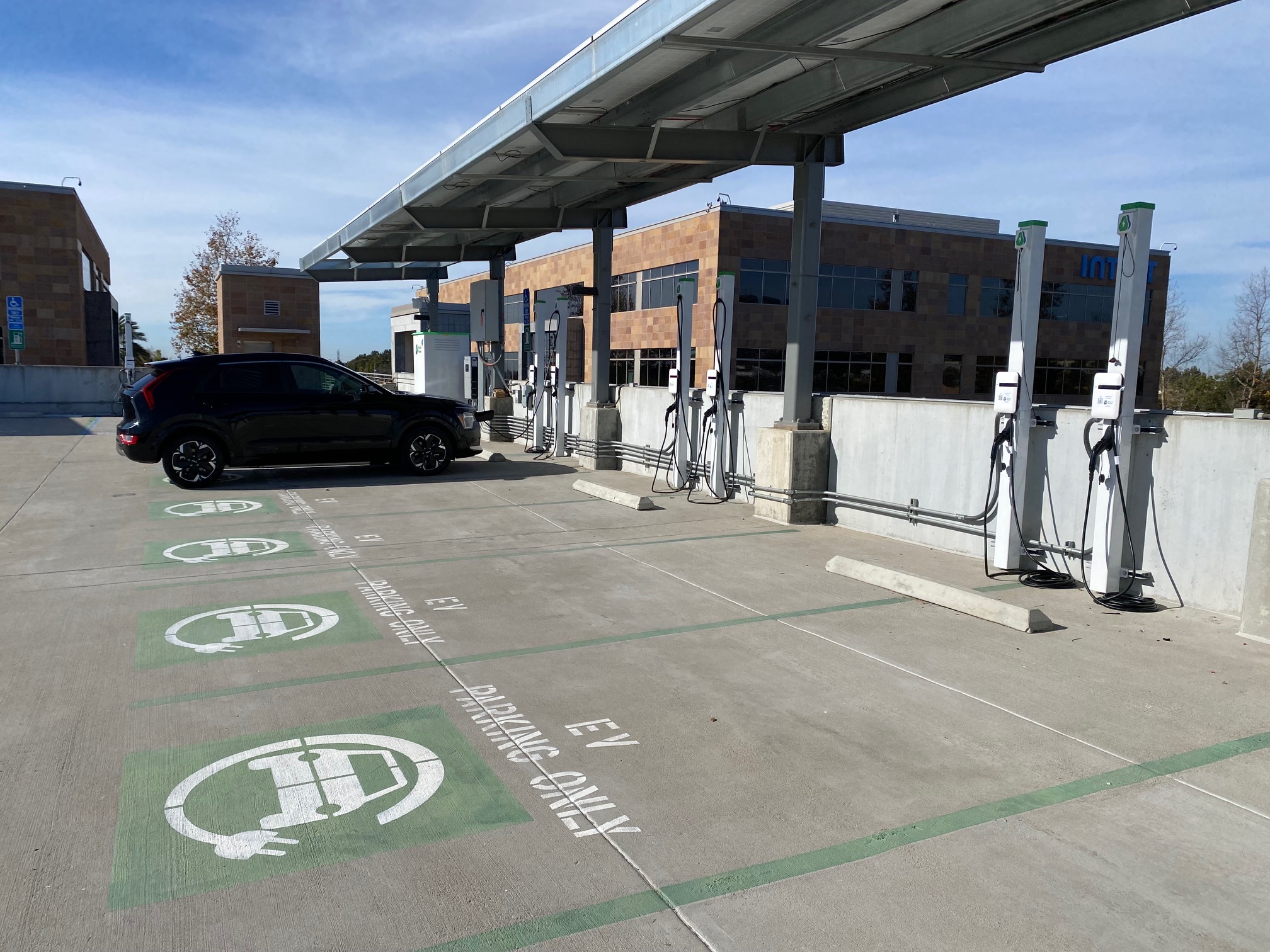
At two Intuit workplace charging projects in California, systems incorporating solar arrays, battery storage and managed EV charging were designed to support six times as many vehicles as the available grid connection could otherwise accommodate.
Paired Power’s PairFleet solution is specifically designed to combine existing grid capacity with intelligent energy management and optional solar and battery storage, allowing commercial properties and fleets to expand charging while minimizing the need for costly utility upgrades.
Learn more about Paired Power’s commercial and fleet EV charging solutions.
Avoiding a Utility Upgrade Starts With Engineering
There isn’t a universal answer to how many EV chargers can be installed on an existing electrical service.
A 400-amp service at one facility may present a completely different opportunity than the same nominal service at another facility because the building’s existing electrical loads, operating schedules, vehicle requirements and utility tariff are different.
That’s why the first step shouldn’t necessarily be asking the utility for more power.
It should be understanding how much power you actually need.
An EV charging engineering analysis can evaluate the site’s existing electrical infrastructure and determine:
- How much capacity is currently available
- How many EVs need to charge
- How much energy those vehicles actually require each day
- When vehicles are available to charge
- Whether charging can be intelligently scheduled
- Whether solar or battery storage would improve the design
- Whether an electrical or utility service upgrade is actually necessary
In some cases, an upgrade will still be the right solution. But in others, engineering and energy management can provide a more economical approach.
Model the System Before You Build It
McCalmont Engineering and Paired Power can also model these variables before equipment is installed.
Paired Power’s Pairiscope™ design software simulates grid capacity, EV fleet requirements, charger types, solar generation, battery storage and utility costs to evaluate how a proposed system will operate in real-world conditions.
That allows project teams to evaluate different scenarios before committing to expensive electrical infrastructure.
For example:
- What happens if you install 20 chargers instead of 10?
- Could 40 Level 2 chargers be managed within the available service capacity?
- Would adding battery storage eliminate the need for an electrical upgrade?
- Would solar reduce annual electricity costs enough to justify adding it to the project?
- Could charging be shifted to different times to reduce peak demand charges?
These are questions that can—and should—be answered during design rather than after construction begins.
Don’t Automatically Assume You Need More Grid Capacity
As EV adoption grows, commercial properties, workplaces and fleets will need considerably more charging infrastructure.
But more chargers don’t automatically have to mean more utility capacity.
Smart EV charging design starts by making better use of the power that’s already available.
Through electrical engineering, intelligent load management, solar generation and battery storage, many sites can significantly expand EV charging capacity while reducing or potentially avoiding costly electrical service upgrades.
McCalmont Engineering provides electrical engineering expertise for solar, energy storage, microgrid and EV charging projects, with the ability to approach these technologies as one integrated energy system.
And through our subsidiary, Paired Power, we can take that approach even further with intelligent EV charging, energy management and microgrid solutions designed specifically for grid-constrained commercial and fleet applications.
Planning an EV charging project and concerned that your existing electrical service isn’t large enough? Contact McCalmont Engineering to evaluate your site’s available capacity and determine your options before committing to a utility upgrade.